

Why a Certificate in Agribusiness Management & Entrepreneurship Matters
It All Begins Here
A Certificate in Agribusiness Management & Entrepreneurship matters because it gives you the business tools to turn agricultural knowledge into profitable, sustainable decisions, while also opening doors to jobs, leadership roles, and venture creation in a growing sector. It is especially valuable for people who want to move from production-only thinking into management, finance, marketing, and market strategy.
Why it matters
Agribusiness is the business and management side of agricultural operations, so the certificate helps you understand how agriculture differs from other industries and how to manage those differences well. Programs like this are designed to build entrepreneurial skills, improve decision-making, and strengthen your ability to use accounting, finance, law, marketing, and management in real agricultural settings.
Career
The certificate can give you a competitive advantage when entering the agriculture and food systems job market, especially because employers consistently value business skills in today's agriculture. It also supports career paths such as agribusiness management, operations, logistics, consulting, business development, and entrepreneurship. For professionals already in the field, it can help you move into leadership and expand from technical work into strategy.
Practical worlds gained
You typically gain applied skills in financial analysis, business planning, pricing, risk management, and market analysis. You also learn how to evaluate business information, use spreadsheets and models, and make stronger decisions around financing, profitability, and enterprise growth. That practical mix is what makes the certificate more than a credential: it can directly improve how you run or advise an agribusiness.
Course Handout: Unit 0
Why a Certificate in International Agribusiness Management and Entrepreneurship Matters
A: INTRODUCTION & CORE CONCEPTS
Welcome to the Program
Welcome to the International Agribusiness Management and Entrepreneurship training program. Whether you are aiming to launch a new venture, expand an existing enterprise, or advance your career in global agriculture, this unit establishes the foundation for your learning journey.
Unit 0 Objective: Understand the value of formal training and certification in agribusiness, identify personal skill gaps, and explore how this 15-unit course will support your entrepreneurial and professional goals.
1. What is this Certificate?
A Certificate in International Agribusiness Management and Entrepreneurship is an official credential that attests to your applied capability in bridging agricultural production with commercial market success.
[Technical Knowledge] + [Business & Management Skills]
= [Sustainable Agribusiness Impact]
While production knowledge is essential, sustainable success in agriculture requires business strategy, financial management, risk assessment, and market positioning.
2. Why Does Agribusiness Require Specialized Skills?
Agribusiness differs significantly from traditional commercial sectors due to unique operational and biological realities:
Perishability & Seasonality: Products require precise timing in logistics, cold chain management, and inventory turnover.
Climate & Biological Vulnerability: Unpredictable weather, pests, and yield fluctuations demand specialized risk-mitigation strategies.
Global Supply Chains & Compliance: Navigating international trade rules, sanitary/phytosanitary standards, and export tariffs require regulatory knowledge.
B: DUAL PATHWAYS & KEY COMPETENCIES
1. Pathway A: For Non-Agricultural Backgrounds
If you come from fields such as business, engineering, tech, or finance and want to invest in agriculture, this program provides the sector-specific competencies necessary to manage risk and optimize operations.
Key Competencies Acquired:
Supply Chain Optimization: Farm-to-table flow management and post-harvest handling.
Market Risk Management: Navigating price volatility, currency fluctuations, and trade policy shifts.
Regulatory Compliance: Meeting international trade regulations, certifications, and quality standards.
Agribusiness Operations: Costing, logistics management, and scaling business models.
2. Pathway B: For Agricultural Specialists
If you already possess a technical background in agronomy, forestry, animal science, environmental management, or food technology, this course provides the commercial and strategic layer to convert technical yields into profitable ventures.
Technical Knowledge (Foundation)
Business Additions (Skill Development)
Commercial Result (Outcome)
• Crop / Animal Science
• Food Technology
• Sustainable Farming
• Market Positioning
• Value Addition
• Financial Planning
• Scalable Enterprise
• Higher Profit Margins
• Investor Readiness
Commercial Capabilities Added:
Value Addition: Processing raw yield into high-margin consumer products.
Branding & Customer Targeting: Differentiating commodities in local and international markets.
Contract & Negotiation: Securing fair supply contracts with distributors and institutional buyers.
C: STRATEGIC ADVANTAGES & CURRICULUM OVERVIEW
1. How the Certificate Creates Strategic Value
A. Unlocking Capital & Funding
Financial institutions and impact investors view agriculture as a high-risk sector. Holding a recognized certificate demonstrates:
Managerial competence and risk awareness.
Sound financial forecasting and budgeting capability.
Reduced operational risk for lenders and equity partners.
B. Accelerating Career Advancement
If your goal is employment rather than immediate business ownership, formal agribusiness training differentiates you in the job market:
Transition from technical/field officer roles to managerial positions.
Demonstrate capability in strategic decision-making, trade compliance, and team leadership.
2. Complete Curriculum Roadmap (15 Units)
Part
Focus Area
Units Included
Part 1
Foundations & Mindset
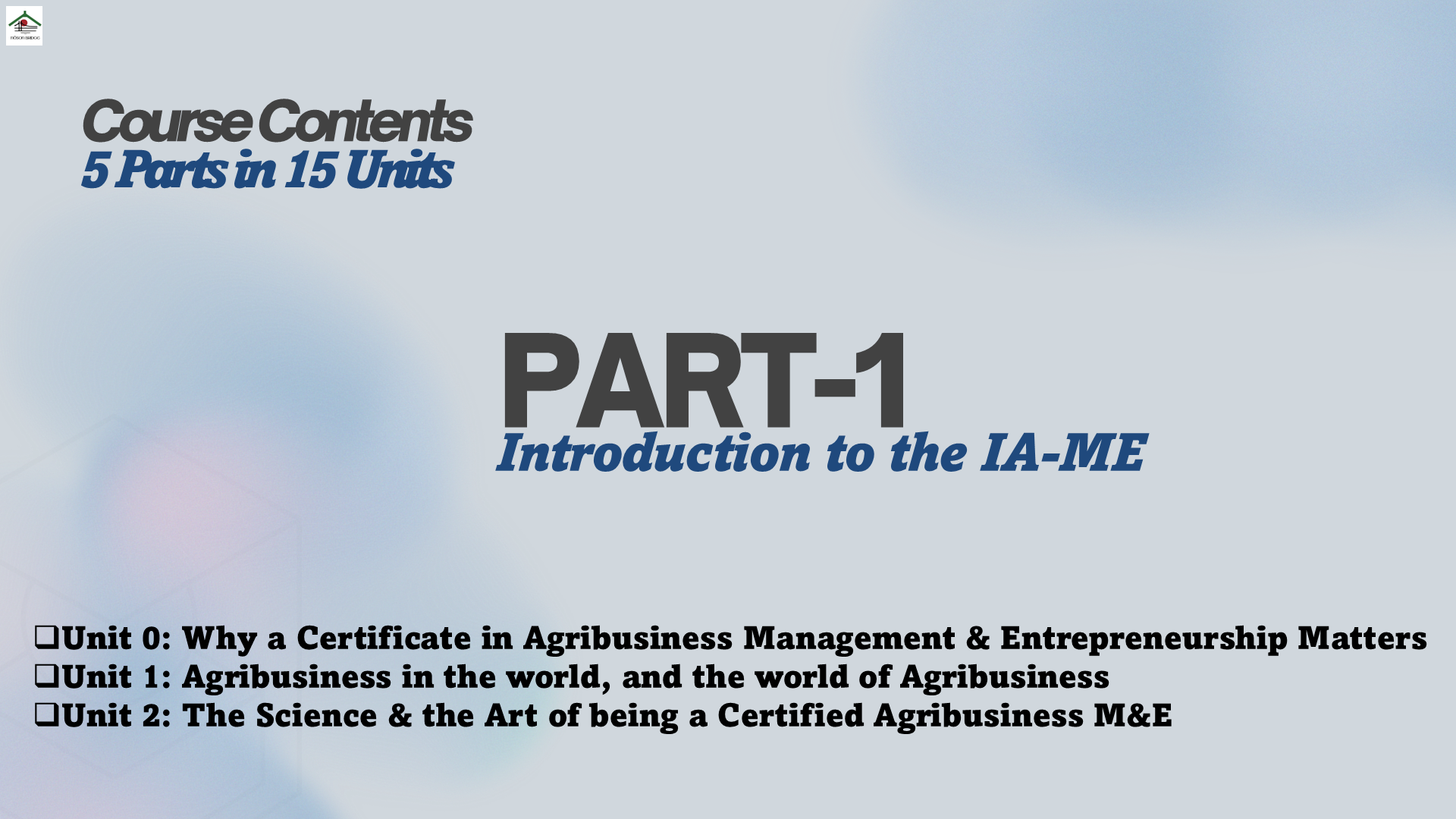
Unit 0: Why the Certificate Matters
Unit 1: The World of Agribusiness
Unit 2: Science & Art of Agribusiness Management
Part 2
Commercialization & Finance
Unit 3: Marketing & Negotiation Management
Unit 4: Customer & Competitor Management
Unit 5: Smart Forecasting & Budgeting
Part 3
Business Setup & Tools
Unit 6: Steps to Setting Up Your Venture
Unit 7: Choosing the Right Legal Identity
Unit 8: Approaches & Tools in Agribusiness
Part 4
Operations & Risk
Unit 9: Produce Well to Sell Well
Unit 10: ABCs of Accounting
Unit 11: Leveraging Budgeting Skills
Unit 12: Agribusiness Risk Management
Part 5
Growth & Leadership
Unit 13: Human Resource Management
Unit 14: Human & Brand Management
Unit 15: Innovation & Scaling
C: SELF-ASSESSMENT & ACTION PLAN
1. Participant Self-Assessment Worksheet
Take a few minutes to evaluate your current background and identify your target areas for growth throughout this course.
Current Background:
[ ] Non-agricultural background (seeking agricultural operational skills)
[ ] Agricultural specialist (seeking commercial and management skills)
[ ] Current agribusiness owner (seeking growth and export capabilities)
Primary Goal:
[ ] Launch a new agribusiness venture
[ ] Expand / scale an existing business
[ ] Transition into a management role within an agricultural organization
[ ] Secure bank loans or investor funding
2. Reflection Questions
What specific gap exists between your current knowledge and your ultimate agribusiness goal?
Which of the 5 Parts of the curriculum is most critical for your immediate needs, and why?
What is one key market or financial risk your potential/existing business faces today?
Next Step: Complete this handout and prepare your answers before proceeding to Unit 1: The World of Agribusiness, where we will examine global trade opportunities, value chains, and market entry strategies!